A Comprehensive Overview of the Bitcoin Ecosystem Part II - Bitcoin Layer 2s
2024-05-08
In our "Comprehensive Overview of the Bitcoin Ecosystem" series, we previously explored inscriptions (Part 1). In this piece, we examine scaling solutions for Bitcoin, with a focus on how recent protocol upgrades enable novel Layer 2 approaches.
What is a Layer 2?
Layer 2 (L2) solutions are technologies designed to improve blockchain performance and scalability by processing transactions off the main chain while inheriting its security guarantees. The key innovation lies in how these solutions leverage Bitcoin's base layer for security while enabling higher throughput.
Rollups batch multiple transactions together, amortizing costs across users. By posting transaction data to the base layer, rollups inherit the security of the underlying blockchain while dramatically increasing throughput.
Validiums, by contrast, store data off-chain and are technically not considered true L2s due to their different security model.
The Taproot upgrade has been instrumental in enabling these new approaches, introducing Segregated Witness improvements, Tapscript, and Schnorr signatures that expand what's possible on Bitcoin.
Secured Rollup vs. Sovereign Rollup
Understanding the distinction between rollup types is crucial for evaluating Bitcoin L2 solutions:
Secured Rollups: Settlement occurs directly on the L1 through smart contracts. The base layer validates all state transitions, providing the strongest security guarantees.
Sovereign Rollups: The L1 provides data availability only; settlement happens on a separate chain. This approach trades some security for implementation flexibility.
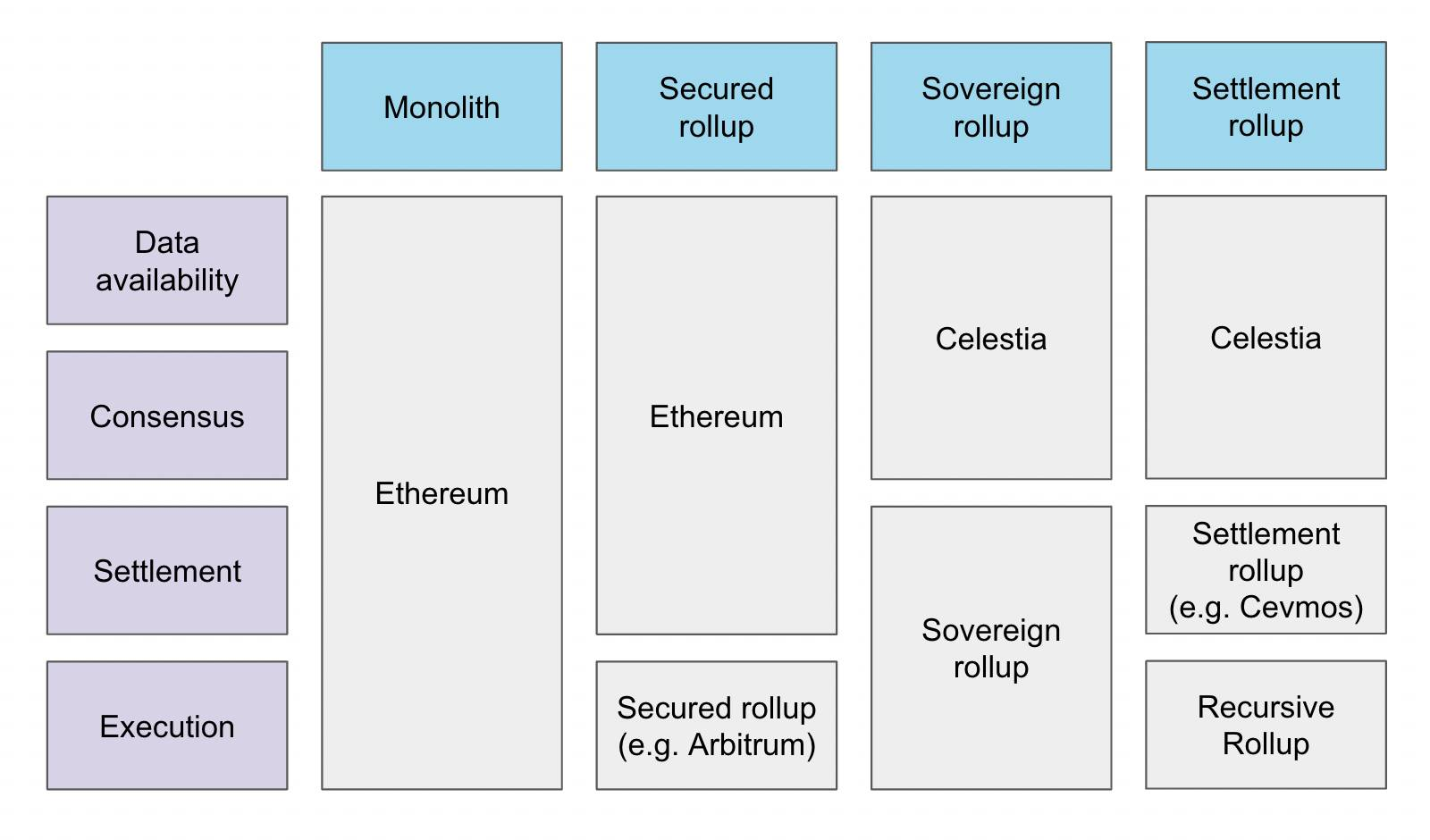
Modular blockchain stack comparison showing different approaches to data availability and settlement (Source: Delphi Digital)
Bitcoin L2 Categories
We categorize Bitcoin L2 solutions into four main approaches, each with distinct tradeoffs:
1. ZK Sovereign Rollups
Zero-knowledge rollups represent one of the holy grails of Bitcoin scaling. These solutions leverage Bitcoin for data availability while handling settlement through their own validation mechanisms.
Key projects in this space include:
- Rollup-as-a-Service frameworks: Rollkit (by Celestia) and Sovereign SDK (by Sovereign Labs)
- Custom implementations: Sigma0/zkBitcoin, Merlin Chain, B² Network, Bison Labs, Bnzk, Kasar Labs, and Taproot Wizards
The primary barrier to ZK rollups on Bitcoin remains that Bitcoin itself does not yet have ZKP verification capabilities due to the lack of a Turing-complete computing environment and potentially block size limitations. Verification of zero-knowledge proofs within the Bitcoin network remains a key technical blocker.
2. Optimistic Rollups (BitVM)
BitVM, developed by ZeroSync, presents an alternative approach that doesn't require protocol changes. Rather than modifying Bitcoin's consensus rules, BitVM leverages Bitcoin's existing scripting language to enable computation verification through fraud proofs and challenge mechanisms.
The key insight is that complex computation can be verified on Bitcoin by breaking it into simple operations that can be disputed. If a prover makes a false claim, a verifier can challenge it and prove fraud using Bitcoin's scripting capabilities.
Citrea, incubated by Chainway, exemplifies this approach by using BitVM to optimistically verify ZK proofs on Bitcoin. This creates a bridge between the benefits of ZK proofs and Bitcoin's current capabilities.
3. Inscriptions (Based Sovereign L2s)
Inscription protocols like BRC-20, Runes, and Atomicals represent a different paradigm. While they use Bitcoin for transaction ordering and data availability, they differ fundamentally from traditional rollups because:
- Transaction throughput remains limited to the base layer's TPS
- One transaction can only contain one inscription
- No batching or compression benefits
These protocols function more as "based" L2s where Bitcoin provides sequencing, but they lack the scaling properties of true rollups.
4. Sidechains
Sidechains represent older scaling approaches with external consensus mechanisms:
- Stacks: Uses BTC for consensus through Proof of Transfer (PoX) but doesn't inherit Bitcoin's full security model
- BEVM: Substrate-based network functioning as an EVM-compatible chain using BTC as gas
- Build on Bitcoin (B.O.B): Uses merged mining with OPStack and RISC Zero zkVM
While sidechains offer immediate scalability, they provide lower security guarantees than rollup-based solutions.
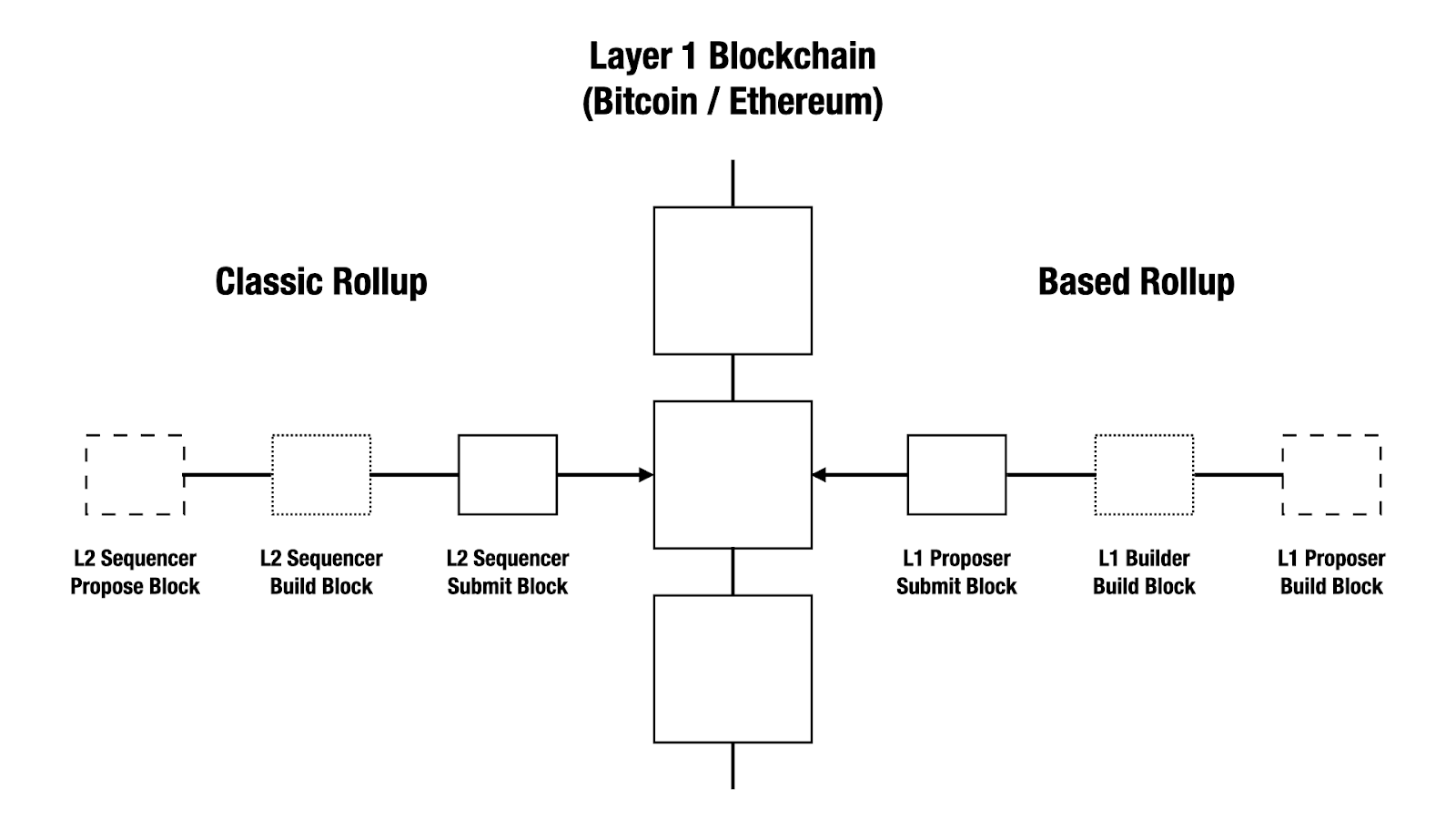
Comparison between Based Rollups and Classic Rollups on Layer 1 blockchains
Security Hierarchy
We rank Bitcoin L2 solutions by their security inheritance from highest to lowest:
- Secured ZK Rollup - Full security inheritance with validity proofs
- Secured Optimistic Rollup - Security through fraud proofs with challenge period
- Sovereign Rollup - Data availability from Bitcoin, settlement elsewhere
- Sidechain - Independent consensus with bridge to Bitcoin
Implementation Timeline
The path to Bitcoin scaling follows a pragmatic timeline:
Short-term: Sovereign Rollups provide immediate scalability improvements without requiring Bitcoin protocol changes. These solutions can launch today and begin serving users while the ecosystem matures.
Mid-term: BitVM-based Optimistic Rollups represent feasible experimentation without opcode modifications. As BitVM tooling matures, more sophisticated applications become possible.
Long-term: Secured ZK Rollups constitute the endgame solution, pending Bitcoin protocol updates that enable native ZK proof verification. This represents the optimal combination of security and scalability.
Conclusion
Finding a balance between short-term scalability solutions and long-term goals is essential as the Bitcoin community continues prioritizing security and decentralization. The stepping-stone approach allows the ecosystem to grow while building toward more robust solutions over time.
The diversity of L2 approaches reflects the vibrant innovation happening in the Bitcoin ecosystem. While no single solution is perfect today, the combination of sovereign rollups, BitVM experimentation, and ongoing protocol research positions Bitcoin for significant scaling improvements in the coming years.